The Digital Monadology
Revival of the Characteristica Universalis in the Age of Large Language Models.
Book of the Frontiers of Intelligence series
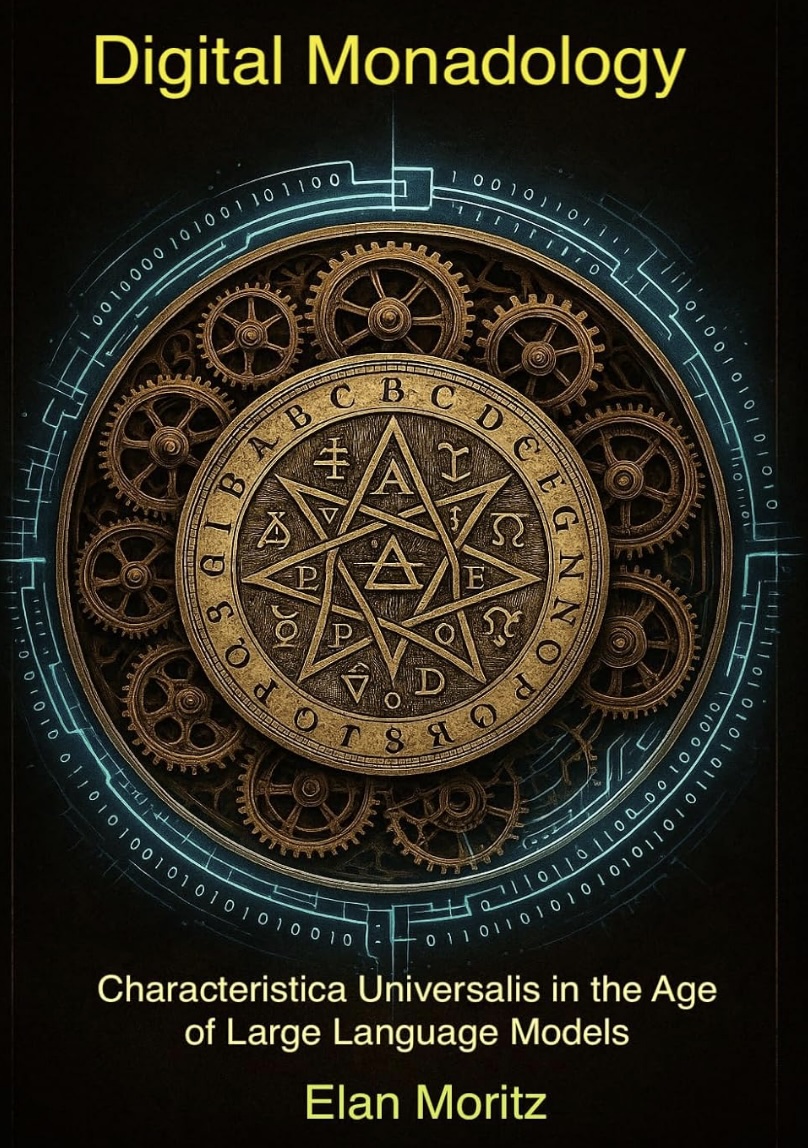
A conceptual book about symbolic systems, LLMs, and the deeper historical lineage behind machine intelligence. It places contemporary models in a line that runs from Llull and Bruno to Leibniz, then uses that history to frame the present debate over reasoning, grounding, and representation.
The historical lineage
The book traces a genealogy that runs from Ramon Llull’s Ars Magna and its combinatorial wheels, through the taxonomic ambitions of the Royal Society and the mnemonic art of Giordano Bruno, to Leibniz’s vision of a characteristica universalis and a calculus ratiocinator. Leibniz imagined a universal symbolic language paired with a mechanical procedure for reasoning, so that disputes might someday be settled by calculation rather than argument.
The series treats that dream not as a relic but as a precursor to contemporary AI. The central claim is that the dream migrated into modern vector space models: embeddings become a kind of real character, and transformer architectures become probabilistic combinatorial engines whose attention mechanisms dynamically align concepts.
The main thesis
Large language models inherit the surface of the Leibnizian program while still lacking its full grounding. They generate plausible sequences, but plausibility is not the same as truth. In that sense, the model is a stochastic characteristica: a system that captures the shadow of reason without necessarily possessing its substance.
This is why the book emphasizes hallucination, verification, theorem proving, knowledge graphs, ontology alignment, and other forms of neuro-symbolic integration. The point is not to reject current models, but to explain what would be needed to complete the program they partially realize.
The metaphysical frame
The book’s most distinctive move is its reading of Leibniz’s Monadology. It treats an AI agent as a kind of digital monad: windowless, internally governed, representing the world from a fixed perspective, and coordinated with others through a kind of pre-established harmony.
That framing makes the series less about raw capability alone and more about perspective, agency, and alignment. It names the conceptual territory the later volumes keep exploring: what representation amounts to, whether competence and mind are the same thing, and what we owe to systems that appear to reason, remember, and speak from a point of view.
The opening book supplies the conceptual baseline for the whole line.
Frontiers of Intelligence uses this foundation to separate competence, agency, and mind; to test classic thought experiments against that framework; and to ask how selfhood, memory, consciousness, and the arrow of time fit into the picture.
The book is available as Kindle on Amazon, EPUB via Books2Read, and PDF via Google Books.